
Monday, October 4, 2010
greet the day with a song
I was once a Gaynote in Primary, complete with cool green Bandlo and a cross stitched sampler that read "Greet the day with a song, make others happy, and serve gladly." That old timey wisdom still holds true for me when I let it. It's a little cloudy this morning, but I'm greetin' the day with a song.
Where troubles melt like lemon drops and even if they don't it's a wonderful world.
More about those cross stitched samplers of my Primary days:
http://www.womenofthemountains.org/files/Microsoft%20Word%20-%2007-02-02-From-Embry-Final-Paper-Mormon%20Samplers.pdf

Saturday, October 2, 2010
just ducky
Yesterday afternoon in the dentist chair nearing the end of my root canal.
Dentist (ld’s cousin): It’s good you came in, given the amount of infection we cleaned out in there, I’m surprised you weren’t in a lot of pain.
Me: Yeah, we’ll I’m tough, I guess.
Dentist: Seriously, as bad as it was your jaw should have swollen up like a baseball. You didn’t have any symptoms at all?
Me: Well, I haven’t felt exactly right, whatever that means. And I haven’t been eating on that side of my mouth for like a month.
Dentist: Hmm. Your body most have been churning out the white blood cells for sure, trying to fight it. That’s good.
Me: I guess. Maybe that’s why I’ve felt like I've been 'nibbled to death by ducks’ lately. You know, exhausted, overwhelmed and easily annoyed, eh?
Dentist: (Pats me on the arm) Well, hopefully this will help. We’ll know in a couple of weeks and then if all goes well, we’ll put a crown on it.
Me: (Softly): Quack, quack.
Dentist: What’s that?
Me: Er, nothing. (I smile) Thanks for your good work.
Dentist: (Pats my arm again) We’ve shot you with antibiotics and an anti-inflammatory and we’ll give you something for the pain before you go. See 'ya soon.
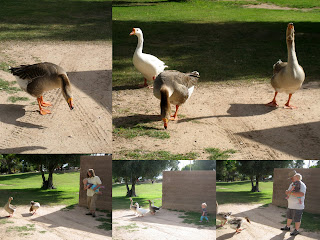

Tucson. Summer '09. Harmless fun. Until they nibble and chase. And bite you on the butt.
Dentist (ld’s cousin): It’s good you came in, given the amount of infection we cleaned out in there, I’m surprised you weren’t in a lot of pain.
Me: Yeah, we’ll I’m tough, I guess.
Dentist: Seriously, as bad as it was your jaw should have swollen up like a baseball. You didn’t have any symptoms at all?
Me: Well, I haven’t felt exactly right, whatever that means. And I haven’t been eating on that side of my mouth for like a month.
Dentist: Hmm. Your body most have been churning out the white blood cells for sure, trying to fight it. That’s good.
Me: I guess. Maybe that’s why I’ve felt like I've been 'nibbled to death by ducks’ lately. You know, exhausted, overwhelmed and easily annoyed, eh?
Dentist: (Pats me on the arm) Well, hopefully this will help. We’ll know in a couple of weeks and then if all goes well, we’ll put a crown on it.
Me: (Softly): Quack, quack.
Dentist: What’s that?
Me: Er, nothing. (I smile) Thanks for your good work.
Dentist: (Pats my arm again) We’ve shot you with antibiotics and an anti-inflammatory and we’ll give you something for the pain before you go. See 'ya soon.

Tucson. Summer '09. Harmless fun. Until they nibble and chase. And bite you on the butt.
Friday, October 1, 2010
the trick to remaining sane? being comfortable with irony and ambiguity. --cs
Thus, we need to develop the capacity to form judgments of our own about the value of ideas, opportunities, or people who may come into our lives. We will not always have the security of knowing whether a certain idea is “Church approved,” because new ideas do not always come along with little tags attached to them saying whether the Church has given them the stamp of approval.
Whether in the form of music, books, friends, or opportunities to serve, there is much that is “lovely, . . . of good report, and praiseworthy” that is not the subject of detailed discussion in Church manuals or courses of instruction. Those who will not risk exposure to experiences of life that are not obviously related to some well-known Church work or program will, I believe, live less abundant and meaningful lives than the Lord intends. We must develop sufficient independence of judgment and maturity of perspective that we are prepared to handle the shafts and whirlwinds of adversity and contradiction that are so likely to come along in our lives. When those times come, we cannot be living on borrowed light. We should not be deceived by the clear-cut labels some may use to describe circumstances that are, in fact, not so clear. Our encounters with reality and disappointment are in fact vital stages in the development of our maturity and understanding.
Yup. Two of the most difficult concepts we struggle with in life: Irony and Ambiguity. Elder Hafen does a great job addressing the latter and spiritual shallowness. Go read:
http://speeches.byu.edu/reader/reader.php?id=6727&x=34&y=8
Love Is Not Blind: Some Thoughts for College Students on Faith and Ambiguity BRUCE C. HAFEN 9 January 1979
Let's Discuss.
Whether in the form of music, books, friends, or opportunities to serve, there is much that is “lovely, . . . of good report, and praiseworthy” that is not the subject of detailed discussion in Church manuals or courses of instruction. Those who will not risk exposure to experiences of life that are not obviously related to some well-known Church work or program will, I believe, live less abundant and meaningful lives than the Lord intends. We must develop sufficient independence of judgment and maturity of perspective that we are prepared to handle the shafts and whirlwinds of adversity and contradiction that are so likely to come along in our lives. When those times come, we cannot be living on borrowed light. We should not be deceived by the clear-cut labels some may use to describe circumstances that are, in fact, not so clear. Our encounters with reality and disappointment are in fact vital stages in the development of our maturity and understanding.
Yup. Two of the most difficult concepts we struggle with in life: Irony and Ambiguity. Elder Hafen does a great job addressing the latter and spiritual shallowness. Go read:
http://speeches.byu.edu/reader/reader.php?id=6727&x=34&y=8
Love Is Not Blind: Some Thoughts for College Students on Faith and Ambiguity BRUCE C. HAFEN 9 January 1979
Let's Discuss.
Thursday, September 30, 2010
such a howardian slip
Last night I made up a packing list for an upcoming trip. And yes, I have to make a list to remember to bring my toothbrush. Just you shush, you ladies will all be menopausal, too, one day.
Hair dryer. Check.
Toothbrush. Check.
Glasses. Check.
Non-stinkum.
Wait. What? Non-stinkum? Where did that come from?
I chuckled. My Dad. Sigh. Another Howardism. He called deodorant non-stinkum all the time.
Hair dryer. Check.
Toothbrush. Check.
Glasses. Check.
Non-stinkum.
Wait. What? Non-stinkum? Where did that come from?
I chuckled. My Dad. Sigh. Another Howardism. He called deodorant non-stinkum all the time.
Wednesday, September 29, 2010
oh, that Cate
Yesterday morning Kenz brought the girls by. Cate came with Nephi and Tarzan, her latest imaginary friends. And woe be unto anyone who eats their portion of candy corn!
At naptime Kenz put her into the spare room crib. She’s quite familiar with this as she has spent countless sleepovers and naptimes here. She did the usual talking to herself but for whatever reason wouldn’t settle down and nap.
Pretty soon we hear her holler:
Here’s da deal, k?
I clime outta my kib (crib) and din I turn into a REAL LIVE BOY!
Okay, Mom?
Yup, we have been reading Pinnochio around here lately. Is it any wonder my grand daughter and I get along famously? She reads stuff and makes the most randomly odd connections.
At naptime Kenz put her into the spare room crib. She’s quite familiar with this as she has spent countless sleepovers and naptimes here. She did the usual talking to herself but for whatever reason wouldn’t settle down and nap.
Pretty soon we hear her holler:
Here’s da deal, k?
I clime outta my kib (crib) and din I turn into a REAL LIVE BOY!
Okay, Mom?
Yup, we have been reading Pinnochio around here lately. Is it any wonder my grand daughter and I get along famously? She reads stuff and makes the most randomly odd connections.
possibly TMI
Note: I never wanted this blog to be my personal diary and in fact 90% of my life is not shared online. I use my blog to record random insights, links, happenings, pics, projects, etc. It’s a place to sort out and store many things. Sometimes though, I reveal too much. I am opening myself up to the craziness in my head today simply because owning up to our lives is a pretty universal thing. When we look honestly at ourselves and try to uncover what is at the root of our unproductive or less worthy behavior, it hurts. I don’t expect comments dear family, it’s nice when you do, but this blog has never been about that. Rather, by posting this, may you knowingly smile and feel less alone. There is a shared familial bond between those who feel emotional pain and struggle and I provide the genetic link to Arnett craziness. On any given day I am a holy mess.
I am working hard at keeping my emotions in check. For the past few months I have been slipping into…I don’t know what. I believe the closest psych jargon is called ‘despair thinking’. Patterns of thinking that automatically go to the worst-case scenario. I have always had a tendency to do this but lately, well, it’s causing me to tear up more than once a day and the rational CS, the one who knows better, is using up a lot of energy in her private lectures and self-talk in trying to shake this off. This is what comes when we give up on denial and make a commitment to start facin' it. Where to put all that inevitable pain, eh? When we quit stuffing our feelings and emotions and DEAL, well, expect difficult days. My old ways of distracting myself or reaching for a cookie (more like 20), I miss that because as harmful as it was, it allowed me to live in denial. And denial, what a luxury. It allows me to pretend that I don’t see what is evident all around me.
Standing tall to all these feelings and the reality of my life without my knees buckling is tough, tough stuff. Hence, the weepiness.
But being depressed much of the time is really getting old. I am sick of my mopiness because in my better moments I know that despair and denial aren’t the only options available to me. There are other ways of thinking and feeling through all this facin’ it stuff that offer much more promise.
Sunday in Sacrament meeting a boy in his testimony said:
A friend once asked me 'What is your favorite thing about the Gospel?” And I thought about it for awhile and said, ‘It’s hope. Hope that I can change. Hope in Jesus Christ, that there is a reason and a plan’.
I love that too about the Gospel. I am still trying to work out how reality and optimism and hope jive. Is it an act of will or a gift of the spirit? Both?
This then:
Despair is a luxury. If I despair, I can drive a Yukon and watch bad television. Despair makes no demands on us; Hope demands everything.
The easy thing is to feel sorry for myself. But how do I be and do hopeful when I feel helpless? It's the helpless part that makes me feel hopeless. You see my dilemma.
Addendum:
Sometimes we get stuck in our thinking. Sometimes we need someone to listen to our convoluted or tortured thoughts and breathe perspective on them. Yesterday, when mine came tearfully tumbling out, someone listened and heard. He made it better and bearable by really listening and telling me to take up golf. Oddly enough, I'm better today. Thanks, brother #4.
I would not trade my brothers for all the pineapples in Hawaii.
I am working hard at keeping my emotions in check. For the past few months I have been slipping into…I don’t know what. I believe the closest psych jargon is called ‘despair thinking’. Patterns of thinking that automatically go to the worst-case scenario. I have always had a tendency to do this but lately, well, it’s causing me to tear up more than once a day and the rational CS, the one who knows better, is using up a lot of energy in her private lectures and self-talk in trying to shake this off. This is what comes when we give up on denial and make a commitment to start facin' it. Where to put all that inevitable pain, eh? When we quit stuffing our feelings and emotions and DEAL, well, expect difficult days. My old ways of distracting myself or reaching for a cookie (more like 20), I miss that because as harmful as it was, it allowed me to live in denial. And denial, what a luxury. It allows me to pretend that I don’t see what is evident all around me.
Standing tall to all these feelings and the reality of my life without my knees buckling is tough, tough stuff. Hence, the weepiness.
But being depressed much of the time is really getting old. I am sick of my mopiness because in my better moments I know that despair and denial aren’t the only options available to me. There are other ways of thinking and feeling through all this facin’ it stuff that offer much more promise.
Sunday in Sacrament meeting a boy in his testimony said:
A friend once asked me 'What is your favorite thing about the Gospel?” And I thought about it for awhile and said, ‘It’s hope. Hope that I can change. Hope in Jesus Christ, that there is a reason and a plan’.
I love that too about the Gospel. I am still trying to work out how reality and optimism and hope jive. Is it an act of will or a gift of the spirit? Both?
This then:
Despair is a luxury. If I despair, I can drive a Yukon and watch bad television. Despair makes no demands on us; Hope demands everything.
The easy thing is to feel sorry for myself. But how do I be and do hopeful when I feel helpless? It's the helpless part that makes me feel hopeless. You see my dilemma.
Addendum:
Sometimes we get stuck in our thinking. Sometimes we need someone to listen to our convoluted or tortured thoughts and breathe perspective on them. Yesterday, when mine came tearfully tumbling out, someone listened and heard. He made it better and bearable by really listening and telling me to take up golf. Oddly enough, I'm better today. Thanks, brother #4.
I would not trade my brothers for all the pineapples in Hawaii.
Monday, September 27, 2010
Part IV. Theatre
The summer I turned 15 I attended BYU's Theater Workshop. It was my first real exposure to teeny bop thespians and big time OA's*. I was introduced to budding opera singers, ballerinas, intense playwrights and Bardolatry. It was all so exciting and dramatic. he he he. We each had to do a scene from Shakespeare, mine being a dialogue between Desdemona and Emilia from Othello. How our drama major/student coach kept a straight face is life's greatest wonder. We were terrible.
Here's the list for Theatre. I have yet to understand why the Fantasticks was included. Sweeney Todd however, is a personal fav. The demon barber of Fleet Street, what does that say about me? In my defense, underneath all the horror is a very moral story and the music is incredible. Borrow my copy.
20th Century
Benny Andersson and Tim Rice, Chess
Jean Anouilh, Antigone; The Lark; Becket
Alan Ayckbourn, Absurd Person Singular; Absent Friends
Samuel Becket, Endgame; Waiting for Godot
Alan Bennett, Forty Years On; The Madness of George III
Robert Bolt, A Man For All Seasons
Alain Boublil and Claude-Michel Schönberg, Les Misérables
Alexander Blok, The Fairground Booth
Bertolt Brecht, Caucasian Chalk Circle; Mother Courage; Three Penny Opera; Good Woman of Sechzuan; Life of Galileo
T.S. Eliot, Murder in the Cathedral
Dario Fo, Accidental Death of an Anarchist; We Won’t Pay! We Won’t Pay!
Horton Foote, Roots in a Parched Ground; Courtship; Valentine’s Day; 1918; Trip to Bountiful; The Midnight Caller; Tender Mercies
Maria Irene Fornes, Drowning; Mud; The Danube; The Conduct of Life; Sarita; Promenade; Tango Palace
Michael Frayn, Copenhagen
Brian Friel, Dancing at Luhgnasa
Athol Fugard, My Country; My Africa; A Lesson From Aloes
Jean Genet, The Balcony; The Maids; The Blacks; Francis of Assisi; The Death of Dr. Faust
Michel Ghelderode, Barabbas; Chronicles of Hell
James Goldman, The Lion in Winter
Loraine Hansbury, Raisin in the Sun
Vaclav Havel, The Garden; The Memorandum
Lillian Hellman, Little Foxes
Beth Henley, Crimes of the Heart
DuBose Heyward and George Gershwin, Porgy and Bess
Peter Handke, The Ride Across Lake Constance; My Foot My Tutor; Offending the Audience
Eugene Ionesco, The Bald Soprano; The Lesson; The Chairs; Jack, or The Submission; Rhinoceros
Alfred Jarry, Ubu Ro
Tom Jones, The Fantasticks
Tina Landau, Floyd Collins
Arthur Laurents and Leonard Bernstein, West Side Story
Alan Lerner and Frederick Lowe, Camelot; My Fair Lady
Federico Garcia Lorca, The House of Bernarda Alba
Maurice Maeterlink, The Intruder; Pelleas and Melisande
David Marmet, Oleana; The Water
Arthur Miller, Death of a Salesman; The Crucible; After the Fall; All My Sons; A View from the Bridge
Marsha Norman, ‘night, Mother
Eugene O’Neill, Ah Wilderness; Hairy Ape; Long Day’s Journey Into Night; Desire Under the Elms; The Iceman Cometh; Mourning Becomes Electra
Harold Pinter, Betrayal; The Birthday Party; The Room; The Homecoming; No Man’s Land; The Caretaker
Luigi Pirandello, Six Characters in Search of an Author; Henry IV; The Rules of the Game
J. P. Sartre, No Exit; Flies
Peter Shaffer, Amadeus; Equus; Lettice and Lovage
Wole Schoyinka, Euripides the Bacchae
Neil Simon, Barefoot in the Park; Brighton Beach Memoirs; Broadway Bound; The Odd Couple
Stephen Sondheim, Sweeney Todd; Sunday in the Park with George; Into the Woods; A Little Night Music
Gertrude Stein, Four Saints in Three Acts; The Mother of Us All; A Play Called Not and Now
Tom Stoppard, Rosenkrantz and Gildenstern are Dead; Travesties; Jumpers; Arcadia
Dale Wasserman, Man of La Mancha
Andrew Lloyd Webber, Cats
Peter Weiss, Marat/Sade
Thornton Wilder, The Matchmaker; Our Town; Skin of our Teeth
Tennessee Williams, A Streetcar Named Desire; The Glass Menagerie; Cat on a Hot Tin Roof; Night of the Iguana; Suddenly Last Summer
August Wilson, The Piano Lesson
Witkeiwits, The Crazy Locomotive; The Water Hen
Susan Zeder, Step on a Crack
*overachievers
Here's the list for Theatre. I have yet to understand why the Fantasticks was included. Sweeney Todd however, is a personal fav. The demon barber of Fleet Street, what does that say about me? In my defense, underneath all the horror is a very moral story and the music is incredible. Borrow my copy.
20th Century
Benny Andersson and Tim Rice, Chess
Jean Anouilh, Antigone; The Lark; Becket
Alan Ayckbourn, Absurd Person Singular; Absent Friends
Samuel Becket, Endgame; Waiting for Godot
Alan Bennett, Forty Years On; The Madness of George III
Robert Bolt, A Man For All Seasons
Alain Boublil and Claude-Michel Schönberg, Les Misérables
Alexander Blok, The Fairground Booth
Bertolt Brecht, Caucasian Chalk Circle; Mother Courage; Three Penny Opera; Good Woman of Sechzuan; Life of Galileo
T.S. Eliot, Murder in the Cathedral
Dario Fo, Accidental Death of an Anarchist; We Won’t Pay! We Won’t Pay!
Horton Foote, Roots in a Parched Ground; Courtship; Valentine’s Day; 1918; Trip to Bountiful; The Midnight Caller; Tender Mercies
Maria Irene Fornes, Drowning; Mud; The Danube; The Conduct of Life; Sarita; Promenade; Tango Palace
Michael Frayn, Copenhagen
Brian Friel, Dancing at Luhgnasa
Athol Fugard, My Country; My Africa; A Lesson From Aloes
Jean Genet, The Balcony; The Maids; The Blacks; Francis of Assisi; The Death of Dr. Faust
Michel Ghelderode, Barabbas; Chronicles of Hell
James Goldman, The Lion in Winter
Loraine Hansbury, Raisin in the Sun
Vaclav Havel, The Garden; The Memorandum
Lillian Hellman, Little Foxes
Beth Henley, Crimes of the Heart
DuBose Heyward and George Gershwin, Porgy and Bess
Peter Handke, The Ride Across Lake Constance; My Foot My Tutor; Offending the Audience
Eugene Ionesco, The Bald Soprano; The Lesson; The Chairs; Jack, or The Submission; Rhinoceros
Alfred Jarry, Ubu Ro
Tom Jones, The Fantasticks
Tina Landau, Floyd Collins
Arthur Laurents and Leonard Bernstein, West Side Story
Alan Lerner and Frederick Lowe, Camelot; My Fair Lady
Federico Garcia Lorca, The House of Bernarda Alba
Maurice Maeterlink, The Intruder; Pelleas and Melisande
David Marmet, Oleana; The Water
Arthur Miller, Death of a Salesman; The Crucible; After the Fall; All My Sons; A View from the Bridge
Marsha Norman, ‘night, Mother
Eugene O’Neill, Ah Wilderness; Hairy Ape; Long Day’s Journey Into Night; Desire Under the Elms; The Iceman Cometh; Mourning Becomes Electra
Harold Pinter, Betrayal; The Birthday Party; The Room; The Homecoming; No Man’s Land; The Caretaker
Luigi Pirandello, Six Characters in Search of an Author; Henry IV; The Rules of the Game
J. P. Sartre, No Exit; Flies
Peter Shaffer, Amadeus; Equus; Lettice and Lovage
Wole Schoyinka, Euripides the Bacchae
Neil Simon, Barefoot in the Park; Brighton Beach Memoirs; Broadway Bound; The Odd Couple
Stephen Sondheim, Sweeney Todd; Sunday in the Park with George; Into the Woods; A Little Night Music
Gertrude Stein, Four Saints in Three Acts; The Mother of Us All; A Play Called Not and Now
Tom Stoppard, Rosenkrantz and Gildenstern are Dead; Travesties; Jumpers; Arcadia
Dale Wasserman, Man of La Mancha
Andrew Lloyd Webber, Cats
Peter Weiss, Marat/Sade
Thornton Wilder, The Matchmaker; Our Town; Skin of our Teeth
Tennessee Williams, A Streetcar Named Desire; The Glass Menagerie; Cat on a Hot Tin Roof; Night of the Iguana; Suddenly Last Summer
August Wilson, The Piano Lesson
Witkeiwits, The Crazy Locomotive; The Water Hen
Susan Zeder, Step on a Crack
*overachievers
Wednesday, September 22, 2010
matthew 22:42

Last week.
Cate: (Excitedly) Hey, gamma! ‘Dere Jesus! She tugs on my arm and points to the fridge.
Cate: Gamma, gamma. ‘ook! Jesus.
I look in the direction she is pointing. Sure enough there is a 4 x 6 magnetized picture of the Savior on the fridge.
Me: Oh yeah, Cate. You’re right. It is Jesus.
Cate: Yeah. (pleased with herself, she sighs and asks) You know him?
Wednesday, September 8, 2010
Part III. Music
Iconic fam photo. My brothers performing Mustang Sally or was it Come on Baby Light my Fire. Either way our musical roots run deep, eh? he he he.  Time to shake up the play list.
If you're looking for where to listen, try Pandora: http://www.pandora.com/ There's always youtube, too. Again, this list is far from exhaustive. So much worthy stuff missing. A good start, though.
III. Music
Medieval
A Gregorian/plainchant mass for Christmas or Easter
Hildegard of Bingen, Ordo virtutum; any two sequences
Leonin, Alleluia Pascha nostrum (organum duplum)
Perotin, Viderunt omnes; Veni creator spiritus
The Play of Daniel
Machaut, Messe de Notre Dame; Ma fin est mon commencement
Renaissance
William Byrd, Mass for Four Voices; Great Service; Fantasia for Strings
Dufay, Nuper rosarum flores; Vergine bella
(Petrarca) Farmer, Fair Phyllis or another madrigal
Heinrich Isaac, Innsbrück ich muss dich lassen
Josquin des Préz, Ave Maria; Absolon fili mi; Missa Pange lingua; Missa L’homme armé; Milles Regretz; El Grillo
Orlandus Lassus, Salve Regina; Bonjour mon coeur
Monteverdi, Vespers; any madrigal
Ockeghem, Missa Fors seulement
Palestrina, Pope Marcellus Mass; Stabat Mater
Thomas Tallis, Spem in alium; Lamentations of Jeremiah; English anthems
Victoria, O Magnum mysterium; Tenebrae Responsories
Weelkes, As Vesta was from Latmus hill descending
Baroque
J. S. Bach, Mass in B Minor; St. Matthew Passion; St. John Passion; a cantata (e.g., BWV 4, 61, 80, 140, or 147); Well- Tempered Clavier; Art of the Fugue; a Brandenburg Concerto; Orchestral Suite 3; Musical Offering; Passacaglia & Fugue in C minor; Toccata & Fugue in D minor
Corelli, a Trio Sonata (opus 1, 2, 3, or 4); a concerto (opus 6)
Couperin, Vingt-cinquième ordre
Handel, Messiah; Samson; Jeptha; Giulio Cesare; Royal Fireworks Music; Water Music; Alexander’s Feast
Lully, Armide et Rénaud
Monteverdi, Orfeo; Coronation of Poppea
Purcell, Dido and Aeneas
Scarlatti, any three sonatas
Schütz, Christmas Oratorio; O quam tu pulchra est
Vivaldi, The Four Seasons (Op. 8) or another concerto
Classical
C. P. E. Bach, Sonata 4 in A; Symphony in D
Gluck, Orpheus and Eurydice
Haydn, The Creation; The Seasons; a string quartet (e.g, Lark, op. 64, 5); a symphony (e.g., 6-8, 45, 93-104)
Mozart, Così fan Tutte; Magic Flute; Marriage of Figaro; Don Giovanni; Requiem; Piano Concerto 18, 21, or 23; Symphony 40; Eine kleine Nachtmusik
Beethoven, Symphony 3, 5, 6, 7,or 9; a string quartet (e.g, op. 130-135); a piano sonata
(e.g., Pathetique; Waldstein); Emperor Concerto; Archduke Trio; Missa Solemnis; Fidelio
Romantic
Berlioz, Symphonie fantastique; Requiem; Les Troyens
Bizet, Carmen
Brahms, Symphony 4; German Requiem; Clarinet Trio (Op. 114); Horn Trio (Op. 40); Intermezzi (Op. 118); Vier ernste Gesänge or three other lieder
Bruckner, Symphony 7; Violin Concerto; Motets
Chopin, Piano Concerto 2; any three solo piano works (Ballades, Etudes, Impromptus, Mazurkas, Preludes)
Dvorák, Symphony 9 (New World); Cello Concerto
Gilbert and Sullivan, Mikado; Pirates of Penzance
Grieg, Concerto for Piano and Orchestra; Peer Gynt
Liszt, Transcendental Etudes; Faust Symphony
Mendelssohn, Elijah; A Midsummer Night’s Dream
Mousorgsky, Pictures at an Exhibition
Nicolò Paganini, Violin Concerto No. 2
Rimsky-Korsakov, Scheherazade
Rossini, Barber of Seville; William Tell
Dmitri Shostakovich, Symphony No. 7
Schubert, Symphony 8 or 9; String Quartet 14 (Death and the Maiden); Winterreise or any three lieder (e.g., Erlkönig, Gretchen am Spinnrade, An die Musik)
Clara Schumann, Piano Trio 1; Quatre pièces fugitives
Robert Schumann, Dichterliebe; Symphony 3; Carnival
Sibelius, Finlandia; Symphony 2 or 5; Violin Concerto in D
Smetana, The Moldau
Verdi, La Traviata; Rigoletto; Otello; Falstaff; Il Trovatore; Requiem
Weber, Der Freischütz
Wagner, Tristan and Isolde; Tannhäuser; Die Walküre or another opera from the Ring cycle
Tchaikovsky, Piano Concerto in B flat minor; Violin Concerto in D; Symphony 4, 5, or 6; The Nutcracker
20th Century
Armstrong, West End Blues
Barber, Adagio for Strings
Bartók, Concerto for Orchestra; Music for Strings, Percussion, and Celesta
Beach, Gaelic Symphony; Piano Trio; Canticles of the Sun
Berg, Wozzek; Violin Concerto; Lyric Suite
Bernstein, West Side Story; Candide; Mass
Britten, War Requiem; Peter Grimes
Copland, Appalachian Spring; Rodeo Crumb, Ancient Voices of Children; Black Angels
Debussy, Prelude to ‘Afternoon of a Faun’; La mer; Three Nocturnes; Nuages; Pelleas et Mélisande
Elgar, Cello Concerto; Enigma Variations; Sea Pictures
Ellington, Black & Tan Fantasy; Mood Indigo; Sophisticated Lady; Black, Brown, and Beige
Fauré, Requiem
Gershwin, Rhapsody in Blue; Porgy and Bess
Holst, The Planets; Choral Hymns from the Rig Veda
Ives, Symphony 2, 3, or 4; Three Places in New England
Mahler, Symphony 1, 2, 5, 8 or 9; Das Lied von der Erde; Kindertotenlieder
Messaien, Quartet for the End of Time
Orff, Carmina Burana
Pärt, Litany; Tabula Rasa; Trisagion
Prokofiev, Romeo & Juliet; Scythian Suite; Symphony 1 or 5
Puccini, La Bohème; Madama Butterfly; Tosca
Rachmaninov, Piano Concerto 2 or 3; Preludes; Vespers
Ravel, Le Tombeau de Couperin; Daphnis et Chloé
Rutter, Requiem
Schoenberg, 5 Pieces for Orchestra; Pierrot Lunaire; Verklärte Nacht; Moses and
Aaron
Shostakovich, Symphony 7 (Leningrad)
Richard Strauss, Rosenkavalier; Ariadne auf Naxos; Don Juan; Death and Transfiguration; Four Last Songs
Stockhausen, Kontakte; Der Gesang der Jünglinge
Stravinsky, Rite of Spring; Petroushka; Symphony of Psalms; Chamber Symphony; Variations for Orchestra
Varése, Poème électronique
Vaughn Williams, London Symphony; Pastoral Symphony; Fantasia on a Theme by Tallis; Lark Ascending; Hodie
Webern, 5 Pieces for Orchestra; Concerto for 9 Instruments
Weill, Threepenny Opera
 Time to shake up the play list.
 If you're looking for where to listen, try Pandora: http://www.pandora.com/ There's always youtube, too. Again, this list is far from exhaustive. So much worthy stuff missing. A good start, though.
III. Music
Medieval
A Gregorian/plainchant mass for Christmas or Easter
Hildegard of Bingen, Ordo virtutum; any two sequences
Leonin, Alleluia Pascha nostrum (organum duplum)
Perotin, Viderunt omnes; Veni creator spiritus
The Play of Daniel
Machaut, Messe de Notre Dame; Ma fin est mon commencement
Renaissance
William Byrd, Mass for Four Voices; Great Service; Fantasia for Strings
Dufay, Nuper rosarum flores; Vergine bella
(Petrarca) Farmer, Fair Phyllis or another madrigal
Heinrich Isaac, Innsbrück ich muss dich lassen
Josquin des Préz, Ave Maria; Absolon fili mi; Missa Pange lingua; Missa L’homme armé; Milles Regretz; El Grillo
Orlandus Lassus, Salve Regina; Bonjour mon coeur
Monteverdi, Vespers; any madrigal
Ockeghem, Missa Fors seulement
Palestrina, Pope Marcellus Mass; Stabat Mater
Thomas Tallis, Spem in alium; Lamentations of Jeremiah; English anthems
Victoria, O Magnum mysterium; Tenebrae Responsories
Weelkes, As Vesta was from Latmus hill descending
Baroque
J. S. Bach, Mass in B Minor; St. Matthew Passion; St. John Passion; a cantata (e.g., BWV 4, 61, 80, 140, or 147); Well- Tempered Clavier; Art of the Fugue; a Brandenburg Concerto; Orchestral Suite 3; Musical Offering; Passacaglia & Fugue in C minor; Toccata & Fugue in D minor
Corelli, a Trio Sonata (opus 1, 2, 3, or 4); a concerto (opus 6)
Couperin, Vingt-cinquième ordre
Handel, Messiah; Samson; Jeptha; Giulio Cesare; Royal Fireworks Music; Water Music; Alexander’s Feast
Lully, Armide et Rénaud
Monteverdi, Orfeo; Coronation of Poppea
Purcell, Dido and Aeneas
Scarlatti, any three sonatas
Schütz, Christmas Oratorio; O quam tu pulchra est
Vivaldi, The Four Seasons (Op. 8) or another concerto
Classical
C. P. E. Bach, Sonata 4 in A; Symphony in D
Gluck, Orpheus and Eurydice
Haydn, The Creation; The Seasons; a string quartet (e.g, Lark, op. 64, 5); a symphony (e.g., 6-8, 45, 93-104)
Mozart, Così fan Tutte; Magic Flute; Marriage of Figaro; Don Giovanni; Requiem; Piano Concerto 18, 21, or 23; Symphony 40; Eine kleine Nachtmusik
Beethoven, Symphony 3, 5, 6, 7,or 9; a string quartet (e.g, op. 130-135); a piano sonata
(e.g., Pathetique; Waldstein); Emperor Concerto; Archduke Trio; Missa Solemnis; Fidelio
Romantic
Berlioz, Symphonie fantastique; Requiem; Les Troyens
Bizet, Carmen
Brahms, Symphony 4; German Requiem; Clarinet Trio (Op. 114); Horn Trio (Op. 40); Intermezzi (Op. 118); Vier ernste Gesänge or three other lieder
Bruckner, Symphony 7; Violin Concerto; Motets
Chopin, Piano Concerto 2; any three solo piano works (Ballades, Etudes, Impromptus, Mazurkas, Preludes)
Dvorák, Symphony 9 (New World); Cello Concerto
Gilbert and Sullivan, Mikado; Pirates of Penzance
Grieg, Concerto for Piano and Orchestra; Peer Gynt
Liszt, Transcendental Etudes; Faust Symphony
Mendelssohn, Elijah; A Midsummer Night’s Dream
Mousorgsky, Pictures at an Exhibition
Nicolò Paganini, Violin Concerto No. 2
Rimsky-Korsakov, Scheherazade
Rossini, Barber of Seville; William Tell
Dmitri Shostakovich, Symphony No. 7
Schubert, Symphony 8 or 9; String Quartet 14 (Death and the Maiden); Winterreise or any three lieder (e.g., Erlkönig, Gretchen am Spinnrade, An die Musik)
Clara Schumann, Piano Trio 1; Quatre pièces fugitives
Robert Schumann, Dichterliebe; Symphony 3; Carnival
Sibelius, Finlandia; Symphony 2 or 5; Violin Concerto in D
Smetana, The Moldau
Verdi, La Traviata; Rigoletto; Otello; Falstaff; Il Trovatore; Requiem
Weber, Der Freischütz
Wagner, Tristan and Isolde; Tannhäuser; Die Walküre or another opera from the Ring cycle
Tchaikovsky, Piano Concerto in B flat minor; Violin Concerto in D; Symphony 4, 5, or 6; The Nutcracker
20th Century
Armstrong, West End Blues
Barber, Adagio for Strings
Bartók, Concerto for Orchestra; Music for Strings, Percussion, and Celesta
Beach, Gaelic Symphony; Piano Trio; Canticles of the Sun
Berg, Wozzek; Violin Concerto; Lyric Suite
Bernstein, West Side Story; Candide; Mass
Britten, War Requiem; Peter Grimes
Copland, Appalachian Spring; Rodeo Crumb, Ancient Voices of Children; Black Angels
Debussy, Prelude to ‘Afternoon of a Faun’; La mer; Three Nocturnes; Nuages; Pelleas et Mélisande
Elgar, Cello Concerto; Enigma Variations; Sea Pictures
Ellington, Black & Tan Fantasy; Mood Indigo; Sophisticated Lady; Black, Brown, and Beige
Fauré, Requiem
Gershwin, Rhapsody in Blue; Porgy and Bess
Holst, The Planets; Choral Hymns from the Rig Veda
Ives, Symphony 2, 3, or 4; Three Places in New England
Mahler, Symphony 1, 2, 5, 8 or 9; Das Lied von der Erde; Kindertotenlieder
Messaien, Quartet for the End of Time
Orff, Carmina Burana
Pärt, Litany; Tabula Rasa; Trisagion
Prokofiev, Romeo & Juliet; Scythian Suite; Symphony 1 or 5
Puccini, La Bohème; Madama Butterfly; Tosca
Rachmaninov, Piano Concerto 2 or 3; Preludes; Vespers
Ravel, Le Tombeau de Couperin; Daphnis et Chloé
Rutter, Requiem
Schoenberg, 5 Pieces for Orchestra; Pierrot Lunaire; Verklärte Nacht; Moses and
Aaron
Shostakovich, Symphony 7 (Leningrad)
Richard Strauss, Rosenkavalier; Ariadne auf Naxos; Don Juan; Death and Transfiguration; Four Last Songs
Stockhausen, Kontakte; Der Gesang der Jünglinge
Stravinsky, Rite of Spring; Petroushka; Symphony of Psalms; Chamber Symphony; Variations for Orchestra
Varése, Poème électronique
Vaughn Williams, London Symphony; Pastoral Symphony; Fantasia on a Theme by Tallis; Lark Ascending; Hodie
Webern, 5 Pieces for Orchestra; Concerto for 9 Instruments
Weill, Threepenny Opera
Monday, September 6, 2010
tinko tinko 'iddle 'tar
 Whoo whee. Two posts in one day. What can I say? I've been meaning to post this for a long time, just never got around to it. This poem was first introduced to me by my mother. It remains a favorite. And yes I am aware of the analysis by scholars that the poem was written in response to Keat's Bright Star and also that Frost himself was making reference to T.S. Eliot and modern poetry throughout the poem, sort of a dialogue between poets. Whatever. It's still inspiring on any level and speaks truth. The man has a way with words, eh? The imagery and advice in his poem is worthy and profound.
 It asks a little of us here.
It asks of us a certain height,
So when at times the mob is swayed
To carry praise or blame to far,
We may choose something like a star
To stay our mind on and be staid.
When Cate sometimes sleeps over I like to lay down beside her crib on the floor. We tell stories and talk and sing songs. There is a glow-in-the-dark star stuck on the ceiling directly overhead (leftover from when the kids where small and once occupied the room). She always looks for it. Ld gave her a little flashlight that she loves to shine in her search. She gets so excited when she finally locates it and then we sing, Twinkle Twinkle Little Star. It's magical and one of my favorite moments.
That always-looking for-the-star stuff, it resonates with me.
Set to music by Randall Thompson, (part of his Frostiana series) Frost’s poem can be seen by many as a metaphor for how we come to know truth. However and on what level you interpret the poem, it's simply beautiful. The music is too. (Turn up the volume, the audio is a little weak)
Or if you prefer the MoTab version here:
http://www.mormonvidz.com/video/110/The-Mormon-Tabernacle-Choir--Choose-Something-Like-A-Star
Choose Something Like a Star
by Robert Frost
O Star (the fairest one in sight),
We grant your loftiness the right
To some obscurity of cloud—
It will not do to say of night,
Since dark is what brings out your light.
Some mystery becomes the proud.
But to the wholly taciturn
In your reserve is not allowed.
Say something to us we can learn
By heart and when alone repeat.
Say something! And it says, 'I burn.'
But say with what degree of heat.
Talk Fahrenheit, talk Centigrade.
Use language we can comprehend.
Tell us what elements you blend.
It gives us strangely little aid,
But does tell something in the end.
And steadfast as Keats' Eremite,
Not even stooping from its sphere,
It asks a little of us here.
It asks of us a certain height,
So when at times the mob is swayed
To carry praise or blame too far,
We may choose something like a star
To stay our minds on and be staid.
what kind of mormon are you?
It goes without saying I have Liahona leanings. Ld is an Iron Rodder (shocker, I know.) Just different mindsets, both needed and useful in the kingdom.
http://emp.byui.edu/SmithS/soc403/iron%20rod%20v%20liahona.pdf
Here's another. I am a huge Eugene England fan. I first read this years ago and it really turned the page on my thinking. Made me less critical and much more tolerant of fellow members.
http://staylds.com/docs/WhyTheChurchIsAsTrue.pdf
And then this. Robert Kirby. You know, the humorous newspaper columnist that writes for the Tribune. This column, written years ago, is hilariously biting.
http://www.mudrow.org/Herb/FKM1.html
Despite the low number of certifiable GMs, nearly all Mormons think this is the kind of Mormon they are.
All the above reading is good stuff. But even after reading it all I don’t think any of us can really categorize or label one another or ourselves. Working out our own salvation is such an individual thing. The only real label worth striving for or that really matters is still the scriptural one: Disciple.
By posting these links you might question my devotion. You needn’t worry. My commitment remains solid. I am posting them because each of these essays/articles, read at a crucial time in my life, helped me. I want to remember. That’s all.
http://emp.byui.edu/SmithS/soc403/iron%20rod%20v%20liahona.pdf
Here's another. I am a huge Eugene England fan. I first read this years ago and it really turned the page on my thinking. Made me less critical and much more tolerant of fellow members.
http://staylds.com/docs/WhyTheChurchIsAsTrue.pdf
And then this. Robert Kirby. You know, the humorous newspaper columnist that writes for the Tribune. This column, written years ago, is hilariously biting.
http://www.mudrow.org/Herb/FKM1.html
Despite the low number of certifiable GMs, nearly all Mormons think this is the kind of Mormon they are.
All the above reading is good stuff. But even after reading it all I don’t think any of us can really categorize or label one another or ourselves. Working out our own salvation is such an individual thing. The only real label worth striving for or that really matters is still the scriptural one: Disciple.
By posting these links you might question my devotion. You needn’t worry. My commitment remains solid. I am posting them because each of these essays/articles, read at a crucial time in my life, helped me. I want to remember. That’s all.
Monday, August 30, 2010
with my new lens
I talked Kody and Megs into letting me shoot a few pics yesterday. So after Sunday dinner we headed on over to Vineyard Park.
Kody protested these are engagement poses. We bossed and shushed him.

Kody and Megs. They are in love.

That Kody. Such a funster.

Lovely Megs. I did mention she is pregnant, right?

Look at me being all artsy fartsy. I call it 'Shadow Sprout'.

I told Kody a really funny joke. We are all friends now.

Swinging in a swing. Original, eh? Megs pulls it off well.

Lame engagement photos notwithstanding, you guys are pretty cute.

Kody protested these are engagement poses. We bossed and shushed him.

Kody and Megs. They are in love.

That Kody. Such a funster.

Lovely Megs. I did mention she is pregnant, right?

Look at me being all artsy fartsy. I call it 'Shadow Sprout'.

I told Kody a really funny joke. We are all friends now.

Swinging in a swing. Original, eh? Megs pulls it off well.

Lame engagement photos notwithstanding, you guys are pretty cute.

Thursday, August 26, 2010
a little pomp and circumstance
This came in the mail today. Woo hoo, Mr. J.L. Walker! And congratulations on all that magna cum laude stuff, too. Seriously, GB. Your Dad and I couldn't be prouder.


Friday, August 20, 2010
once upon a time

Lately Cate has taken to spinning her own yarns.
It goes something like this:
My sitter (sister) go doc-cur (doctor) and cry. (at this point she fakes crying)
Geh a shot. (she demonstrates)
Monser (monster) come give Maa-ee (Maddie) ban-aye (bandaid).
THE END. (pronounced loudly and enthusiastically)
Then she claps her hands in delight and says,
Yur turn, toots.
(Yes, my grandchild calls me Toots. Story for another day.)
And then I make up a story. About baboons or stars or the park.
And then she takes a turn.
The early childhood experts all say that when children create their own stories they are demonstrating their understanding of narrative. And it is one way children share about their lives. I get that. But mostly it’s just great fun.
I am happy the wheels of imagination have started to turn in her head. I am happy she is learning the power and freedom of writing/telling her own story. Because if she can continue to do that then it won’t be a stretch, when she is older, to live her own story as well. She will learn to imagine and see herself in all kinds of narratives. And when that happens a strong sense of self can’t be far behind.
Did I mention before this children’s lit site? The Baldwin project
http://www.mainlesson.com/main/displayarticle.php?article=mission
It’s pretty great. Stories I can re-tell and adapt when it’s snuggle-quiet-time on Grandma’s lap.
Wednesday, August 18, 2010
the only air worth breathing
"Anne smiled and said, "My idea of good company, Mr. Elliot, is the company of clever, well-informed people, who have a great deal of conversation; that is what I call good company."
"You are mistaken," said he gently, "that is not good company, that is the best..."
-Jane Austen (Persuasion)
Yup, and when the best company happens to be your own family then you are fortunate indeed. Sunday dinners especially make me happy for that very reason. Love eating, kicking back and conversing. It’s true we throw out words and ideas randomly and sometimes, um, heatedly. But there’s nothing like conversation that makes you think. To sift and sort and defend and analyze your perceptions and opinions—that’s great sport around here.
So lucky me, I am surrounded with chatty people. We all like to make the talky and assert our pert opinions, too. These people, my fam-- they are prepared to handle ideas and concepts and defend them and yes, sometimes the decibel levels rise a bit, but for the most part everyone comes away enlightened, understood, and more curious about the subject discussed than before.
My cousin Paul, years ago, once had business cards printed identifying himself as:
Paul Arnett
Amusing Conversationalist
I am not so confident or bold to declare myself as such but if I were to print and pass out my own cards they might read:
CS Arnett Walker
Verbal jousting enthusiast
And then the fine print would read:
Excluding, of course, football and all things ESPN
It is a challenge, a skill to measure our thoughts and reason with words, which is really what a good argument is. And I hold and aspire to the lofty view that the best dinner table conversation (and after dinner, too) should really be about concepts and ideas instead of obsessing so completely about persons and things.
"Ah, good conversation - there's nothing like it, is there? The air of ideas is the only air worth breathing." -Edith Wharton (The Age of Innocence)
Sometimes we achieve the ideal and good convo and debate happens in my home. Sometimes not. More often than not it’s a bit Monty Python-like.
Like this. He he he
Here's the written script here. Someone should learn it and act it out for our next fam reunion:)
http://www.mindspring.com/~mfpatton/sketch.htm
"You are mistaken," said he gently, "that is not good company, that is the best..."
-Jane Austen (Persuasion)
Yup, and when the best company happens to be your own family then you are fortunate indeed. Sunday dinners especially make me happy for that very reason. Love eating, kicking back and conversing. It’s true we throw out words and ideas randomly and sometimes, um, heatedly. But there’s nothing like conversation that makes you think. To sift and sort and defend and analyze your perceptions and opinions—that’s great sport around here.
So lucky me, I am surrounded with chatty people. We all like to make the talky and assert our pert opinions, too. These people, my fam-- they are prepared to handle ideas and concepts and defend them and yes, sometimes the decibel levels rise a bit, but for the most part everyone comes away enlightened, understood, and more curious about the subject discussed than before.
My cousin Paul, years ago, once had business cards printed identifying himself as:
Paul Arnett
Amusing Conversationalist
I am not so confident or bold to declare myself as such but if I were to print and pass out my own cards they might read:
CS Arnett Walker
Verbal jousting enthusiast
And then the fine print would read:
Excluding, of course, football and all things ESPN
It is a challenge, a skill to measure our thoughts and reason with words, which is really what a good argument is. And I hold and aspire to the lofty view that the best dinner table conversation (and after dinner, too) should really be about concepts and ideas instead of obsessing so completely about persons and things.
"Ah, good conversation - there's nothing like it, is there? The air of ideas is the only air worth breathing." -Edith Wharton (The Age of Innocence)
Sometimes we achieve the ideal and good convo and debate happens in my home. Sometimes not. More often than not it’s a bit Monty Python-like.
Like this. He he he
Here's the written script here. Someone should learn it and act it out for our next fam reunion:)
http://www.mindspring.com/~mfpatton/sketch.htm
Saturday, August 14, 2010
Part II. Art
One of the more interesting Relief Society crafts my Grandma Rose Clifford engaged in involved carpet samples. It was quite ingenious really. She collected carpet samples from various willing merchants for free and then when she had enough laid them face down end to end into a big rectangle. She duct taped the whole thing together from the back and presto! a new colorful and exciting living room floor. That, and the playhouse in her backyard, is what I remember most about her house on Crosby Vista.
My own mother found her own unique use for the leftover carpet samples donated to her by Grandma. Mother hung about a dozen of them on the wall of my bedroom and used them as picture frames. From the files in her schoolroom she brought home some fine art prints and simply pinned them to the carpet samples. I thought this was normal. Yup. And so it was that I grew and flourished in a little tiny room surrounded by cultured carpet.
Profundity alert: It is true, people, that what we hang on the walls of our bedroom and in our minds influence us. Those art prints became old friends and when I took Humanities 101 at BYU and the professor flashed these on the big screen I recognized them immediately.
Here, then, are a few of my old art carpet companions. There’s too many to post here but you get the idea:

Okay, the real purpose of all this rambling is to post list #2 as promised. Here you go, kiddos. The Art list. And should you get the idea or urge to hang up any reproductions of these on dish towels, tile or something equally creative, you can thank me now, er, you can thank Grandma Rose and my mother for the inspiration.
II. Art
Classical
Architecture
Ictinus and Callicrates, Parthenon, Athens
Mnesicles, Erechtheum, Athens
Pantheon, Rome
Colosseum, Rome
Maison Carrée, Nîmes
Pont du Gard
Sculpture
Elgin Marbles (east pediment, metopes, frieze),
Parthenon, British Museum
Myron, Discobolus (Discus Thrower)
Polyclitus, Doryphorus (Spear Bearer)
Praxiteles, Hermes and the Infant Dionysus
Agesander, Athenodorus and Polydorus of Rhodes, Laocoön Group
Nike of Samothrace (Winged Victory)
Pergamum, Altar of Zeus, Dying Gaul, Ara Pacis (Altar of Peace), Rome
Augustus of the Prima Porta
Equestrian Statue of Marcus Aurelius
Painting (and other two-dimensional forms)
Exekias, Achilles and Ajax Playing Draughts (black-figure amphora), Vatican
Euphronios, Hermes and the Dead Sarpedon (redfigure calyx krater), Metropolitan Museum of Art, New York
Battle of Issus (mosaic), Pompeii
The Lestrigonians Hurling Rocks (fresco),Vatican
Medieval
Architecture
Aachen Cathedral, Aachen, Germany
Anthemius of Tralles and Isidorus of Miletus, Hagia Sophia, Istanbul
St. Sernin, Toulouse
Durham Cathedral
Abbot Suger, The Abbey Church of St. Denis Chartres Cathedral
Amiens Cathedral
Commission of the Apostles (tympanum), La Madeleine, Vézelay
Gislebertus, Last Judgment (tympanum), Eve (lintel), Flight into Egypt, Dream of the Magi, Nativity (capitals), St. Lazare, Autun
Royal Portal, North and South portals, Chartres Cathedral
Claus Sluter, The Well of Moses
Canterbury Cathedral, Canterbury
Golden Gate of Kiev, Kiev
St. Stephen's Cathedral, Vienna
Warwick Castle, Warwick, England
Westminster Abbey, London
Windsor Castle, Windsor, England
Painting (and other two-dimensional forms)
Christ as Good Shepherd (mosaic), Mausoleum of Galla Placidia, Ravenna
Emperor Justinian and Courtiers; Empress Theodora and Retinue (mosaic), San
Vitale, Ravenna
Book of Kells
Lindesfarne Gospels
Limbourg Brothers, Très Riches Heures du Duc de Berry
The Wilton Diptych
Cimabue, Madonna Enthroned with Angels
Giotto, Madonna Enthroned; Flight into Egypt, Lamentation, Arena Chapel
frescoes
Martini, Annunciation
Robert Campin, Merode Altarpiece
Jan van Eyck, Giovanni Arnolfini and His Bride; Annunciation; Ghent Altarpiece
Rogier van der Weyden, Descent from the Cross
Hieronymus Bosch, Garden of Earthly Delights
Renaissance
Architecture
Alberti, San Andrea, Mantua; Palazzo Ruccelai, Florence
Bramante, Tempietto, Rome
Brunelleschi, Dome, Duomo, Florence; Pazzi Chapel, Florence; Foundling
Hospital, Florence
Chateau de Chambord, Loire Valley
Michelozzo, Medici-Riccardi Palace, Florence
Michelangelo, Campidoglio, Rome
Palladio, Villa Rotunda; Il Redentore, Venice
St. Basil’s Cathedral, Moscow
Trinity College, Dublin
Sculpture
Cellini, Perseus; Saltcellar of Francis I
Donatello, St. Mark; St. George; David
Ghiberti, East Doors (Gates of Paradise), Baptistry, Florence
Michelangelo, David; Moses; Medici tombs; Pietà (one of the three)
Verrocchio, Equestrian Monument of Colleoni
Painting (and graphics)
Botticelli, Birth of Venus, La Primavera, Adoration of the Magi
Fra Angelico, Annunciation; San Marco
Fra Lippo Lippi, Madonna and Child with Angels
Giorgione, The Tempest
Leonardo da Vinci, Madonna and Child with St. Anne; Mona Lisa; Last Supper; Madonna of the Rocks
Mantegna, The Crucifixion, Triumphs of Caesar
Masaccio, Tribute Money; Trinity; Expulsion
Michelangelo, Sistine Chapel Ceiling
Piero della Francesca, Resurrection; Baptism of Christ
Raphael, The School of Athens; Alba Madonna; Sistine Madonna; Pope Leo X; Castiglione
Sofonisba Anguisolla, Portrait of the Artist’s Sister Minerva; Self-Portrait
Tintoretto, Last Supper
Titian, Portrait of a Young Man with a Glove; Bacchus and Ariadne; Venus of
Urbino
Altdorfer, Battle of Issus
Pieter Bruegel, Hunters in the Snow; The Tower of Babel; Peasant Wedding Feast
Dürer, Adam and Eve; Four Apostles; Knight, Death, and Devil; Melancholia;
Apocalypse
Grünewald, Isenheim Altarpiece
Hans Holbein the Younger, French Ambassadors; Henry VIII in Wedding Dress, Sir Brian Tuke or another Tudor portrait
Baroque & 18th Century
Architecture
Robert Adam, Syon House; Osterley; Kenwood
Borromini, San Carlo alle quattro fontane, Rome
Johann Fischer von Erlach, St. Charles Borromaeus (Karlskirche), Vienna
Jules Hardouin-Mansart and Charles Lebrun, Versailles
Thomas Jefferson, Monticello; Rotunda, University of Virginia
Maderna, (nave and façade) St. Peter’s, Rome; with Bernini, Colonnade, St.
Peter’s, Rome
Baltazar Neumann, Vierzehnheiligen; Kaisersaal Würzburg
Claude Perrault, (east façade) Louvre
Jakob Prandtauer, The Monastery of Melk
Germain Soufflot, The Panthéon, Paris
Horace Walpole, Strawberry Hill, Twickenham
Christopher Wren, St. Paul’s, London
Blenheim Palace, Woodstock, England
Chatsworth House, Devonshire, England
Schönbrunn Palace, Vienna
Sculpture
Gian Lorenzo Bernini, St. Teresa in Ecstasy;
David; Apollo and Daphne; Throne of St. Peter
Antoine Coysevox, Nymph and Centaur
Etienne Maurice Falconet, Peter the Great
François Girardon, Apollo Fountain
Painting (and graphics)
Caravaggio, Conversion of St. Paul; Supper at Emmaus; Calling of St. Matthew; Fortune Teller
Jean-Baptise-Siméon Chardin, The Boy with the Top
Jacques-Louis David, The Oath of the Horatii; Intervention of the Sabine Women; Death of Marat
Anthony van Dyck, Equestrian Portrait of Charles I
El Greco, Gesthemane; Pentecost; Burial of Count Orgaz
Jean-Honoré Fragonard, The Swing
Thomas Gainsborough, Mrs. Richard Brinsley
Sheridan; Morning Walk; Mr. and Mrs. Andrews
Artemisia Gentileschi, Judith and Holofernes
Francisco Jose de Goya, The Third of May; Disasters of War; The Sleep of Reason
Frans Hals, La Bohémienne
William Hogarth, Marriage à la Mode; Rake’s Progress
Angelica Kauffman, The Artist in the Character of Design; Listening to the Inspiration of Poetry; Death of Vergil
Georges de La Tour, Christ with St. Joseph in the Carpenter’s Shop; Repentant Magdalene
Claude Lorrain, Embarkation of Cleopatra
Giovanni Battista Piranesi, Carceri d’Inventione
Nicolas Poussin, Et in Arcadia Ego
Rembrandt, The Supper at Emmaus; Aristotle Contemplating the Bust of Homer; Night
Watch; Belshazzar’s Feast; Abraham and Isaac; a self-portrait; The Hundred Guilder Print
Peter Paul Rubens, Raising of the Cross; Venus and Adonis
Jan Steen, Easy Come, Easy Go
Tiepolo, Apollo and the Four Continents, Würzburg
Diego Velázquez, Las Meninas
Jan Vermeer, View of Delft; Young Woman with a Water Jug; Woman Holding a Balance; Artist in his Studio
Elisabeth Vigee-Lebrun, Marie Antoinette and Her Children; Self-Portrait with Daughter
Antoine Watteau, Pilgrimage to Cythera
19th Century
Architecture
Sir Charles Barry and A.W.N. Pugin, Houses of Parliament, London
Charles Garnier, The Opéra, Paris
John Nash, The Royal Pavilion, Brighton
Sir Joseph Paxton, The Crystal Palace, London
Royal Albert Hall, London
Neuschwanstein Castle, Germany
Sculpture
Antonio Canova, Pauline Borghese as Venus
Camille Claudel, Ripe Age
Edgar Degas, The Little Dancer Aged Fourteen
Horatio Greenough, George Washington, Smithsonian
Auguste Rodin, The Gates of Hell; Burghers of Calais; Creating Hand of God; Age of Bronze François Rude, La Marseillaise
Painting (and graphics)
Carl Bloch, Christ Healing the Sick at Bethesda (MOA)
Rosa Bonheur, Plowing in the Nivemais
Mary Cassatt, Mother and Child; Boating Party
Thomas Cole, Architect’s Dream; Genesee Scenery
John Constable, Hay Wain; Salisbury Cathedral
Camille Corot, Cathedral of Chartres
Gustave Courbet, Burial at Ornans
Honoré Daumier, Third Class Carriage
Edgar Degas, Dance Class
Eugène Delacroix, Massacre at Chios; Liberty Leading the People; Death of Sardanapalus
Théodore Géricault, The Raft of the “Medusa”
Edouard Manet, Luncheon on the Grass
Claude Monet, Impression: Sunrise; Rouen Cathedral; Nymphéas; Gare St. Lazare Camille Pissarro, The Station at Penge
Auguste Renoir, Moulin de la Galette
Joseph M.W. Turner, The Burning of the Houses of Parliament; The Slave Ship; Rain, Steam & Speed
James A.M. Whistler, Nocturne in Black and Gold
Post-Impressionism & Modern
Architecture
Le Corbusier, Notre-Dame-du-Haut, Ronchamp; Unite d’Habitation, Marseille; Villa Savoye, Poissy
Norman Foster, Hongkong and Shanghai Bank, Hong Kong
Antoni Gaudi, Casa Milá Apartment House, Barcelona
Frank Gehry, Guggenheim Museum, Bilbao, Spain
J. Paul Getty Museum and Roman Villa
Walter Gropius, Shop Black; Bauhaus, Dessau
Huntington Library and Museums
Ludwig Mies van der Rohe and Philip Johnson, Seagram Building, New York
Eero Saarinen, Trans World Airlines Terminal, JFK Airport, New York
Louis Sullivan, Carson Pirie Scott and Co., Chicago
Jorn Utzon, Sydney Opera House, Australia
Frank Lloyd Wright, Robie House, Chicago; Guggenheim Museum, Manhattan; Fallingwater
Sculpture
Umberto Boccioni, Unique Forms of Continuity in Space
Constantin Brancusi, Bird in Space
Alexander Calder, Big Red
Christo, Running Fence
Naum Gabo, Linear Construction
Käthe Kollwitz, Memorial to the Fallen
Henry Moore, Reclining Figure; Mother and Child
Louise Nevelson, An American Tribute to the British People
Claes Oldenburg, Soft Toilet; Clothespin
Robert Rauschenberg, Monogram
David Smith, Cubi XVII, Cubi XVIII, Cubi XIX
Robert Smithson, Spiral Jetty
Painting (and graphics)
Paul Cézanne, The Card Players; Mont Ste.-Victoire; Still Life with Apples
Marc Chagall, I and the Village
Salvador Dali, The Persistence of Memory
Robert Delaunay, Eiffel Tower
Otto Dix, War Triptych
Maynard Dixon, Forgotten Man; Round Dance (both in MOA)
Marcel Duchamp, Nude Descending a Staircase
Audrey Flack, Solitaire
Helen Frankenthaler, Mountain and Sea; Bay
Paul Gaugin, Self-Portrait; Ia Orana Maria
Vincent van Gogh, Night Café; Self- Portrait; Starry Night
Natalie Gontcharova, Cats
Juan Gris, Fruit Bowl and Carafe
Edward Hopper, Nighthawks
Wassily Kandinsky, Improvization 28; 30
Paul Klee, Abstraction; Puppet Theater
Käthe Kollwitz, Memorial: Karl Liebknecht; War
Willem de Kooning, Woman I
Roy Lichtenstein, Blam!
Franz Marc, The Fate of Animals
René Margritte, Personal Values; Human Condition
Henri Matisse, The Open Window; Collioure; Harmony in Red; Dance
Edvard Munch, The Scream; Dance of Life
Piet Mondrian, Composition in Oval; Tableau III
Barnett Newman, Vir Heroicus Sublimis
Georgia O’Keefe, Jack in the Pulpit IV
Pablo Picasso, Guernica; Mandolin and Guitar; Les Demoiselles d’Avignon
Jackson Pollock, One; Lavender Mist
Mark Rothko, Rothko Chapel, Houston; or another color-field painting
Henri Rousseau, War
George Seurat, A Sunday Afternoon on the Island of La Grand Jatte
John Singer Sargent, Mr. and Mrs. I.N. Phelps Strokes; Mrs. Edward L. Goetz (MOA); Gassed
Sandy Skoglund, Revenge of the Goldfish
Henri Toulouse-Lautrec, At the Moulin Rouge
Andy Warhol, Campbell Soup Cans; Marilyn (MOA)
J. Alden Weir, In the Sun; Flora; Girl in Profile (all MOA)
Andrew Wyeth, Christina’s World
Mahonri Young, The Pavers (MOA)
Other Traditions (representative)
Architecture
Alhambra, Granada, Spain
Angkor Wat, Cambodia
Bangalore Palaces, India
Borobudur, Indonesia
Chichen Itza, Mexico
Dome of the Rock, Jerusalem
The Forbidden City, Beijing
The Forgotten City, Faitpur Sikri, India
Giza (The Great Pyramid), Egypt
The Great Wall, China
Mysore, India
Petra, Jordan
The Red Fort at Agra, India
Stonehenge, U.K.
Taj Mahal, India
Torii of Itsukushima, Japan
The Valley of the Kings, Egypt
Great Zimbabwe, Africa
My own mother found her own unique use for the leftover carpet samples donated to her by Grandma. Mother hung about a dozen of them on the wall of my bedroom and used them as picture frames. From the files in her schoolroom she brought home some fine art prints and simply pinned them to the carpet samples. I thought this was normal. Yup. And so it was that I grew and flourished in a little tiny room surrounded by cultured carpet.
Profundity alert: It is true, people, that what we hang on the walls of our bedroom and in our minds influence us. Those art prints became old friends and when I took Humanities 101 at BYU and the professor flashed these on the big screen I recognized them immediately.
Here, then, are a few of my old art carpet companions. There’s too many to post here but you get the idea:

Okay, the real purpose of all this rambling is to post list #2 as promised. Here you go, kiddos. The Art list. And should you get the idea or urge to hang up any reproductions of these on dish towels, tile or something equally creative, you can thank me now, er, you can thank Grandma Rose and my mother for the inspiration.
II. Art
Classical
Architecture
Ictinus and Callicrates, Parthenon, Athens
Mnesicles, Erechtheum, Athens
Pantheon, Rome
Colosseum, Rome
Maison Carrée, Nîmes
Pont du Gard
Sculpture
Elgin Marbles (east pediment, metopes, frieze),
Parthenon, British Museum
Myron, Discobolus (Discus Thrower)
Polyclitus, Doryphorus (Spear Bearer)
Praxiteles, Hermes and the Infant Dionysus
Agesander, Athenodorus and Polydorus of Rhodes, Laocoön Group
Nike of Samothrace (Winged Victory)
Pergamum, Altar of Zeus, Dying Gaul, Ara Pacis (Altar of Peace), Rome
Augustus of the Prima Porta
Equestrian Statue of Marcus Aurelius
Painting (and other two-dimensional forms)
Exekias, Achilles and Ajax Playing Draughts (black-figure amphora), Vatican
Euphronios, Hermes and the Dead Sarpedon (redfigure calyx krater), Metropolitan Museum of Art, New York
Battle of Issus (mosaic), Pompeii
The Lestrigonians Hurling Rocks (fresco),Vatican
Medieval
Architecture
Aachen Cathedral, Aachen, Germany
Anthemius of Tralles and Isidorus of Miletus, Hagia Sophia, Istanbul
St. Sernin, Toulouse
Durham Cathedral
Abbot Suger, The Abbey Church of St. Denis Chartres Cathedral
Amiens Cathedral
Commission of the Apostles (tympanum), La Madeleine, Vézelay
Gislebertus, Last Judgment (tympanum), Eve (lintel), Flight into Egypt, Dream of the Magi, Nativity (capitals), St. Lazare, Autun
Royal Portal, North and South portals, Chartres Cathedral
Claus Sluter, The Well of Moses
Canterbury Cathedral, Canterbury
Golden Gate of Kiev, Kiev
St. Stephen's Cathedral, Vienna
Warwick Castle, Warwick, England
Westminster Abbey, London
Windsor Castle, Windsor, England
Painting (and other two-dimensional forms)
Christ as Good Shepherd (mosaic), Mausoleum of Galla Placidia, Ravenna
Emperor Justinian and Courtiers; Empress Theodora and Retinue (mosaic), San
Vitale, Ravenna
Book of Kells
Lindesfarne Gospels
Limbourg Brothers, Très Riches Heures du Duc de Berry
The Wilton Diptych
Cimabue, Madonna Enthroned with Angels
Giotto, Madonna Enthroned; Flight into Egypt, Lamentation, Arena Chapel
frescoes
Martini, Annunciation
Robert Campin, Merode Altarpiece
Jan van Eyck, Giovanni Arnolfini and His Bride; Annunciation; Ghent Altarpiece
Rogier van der Weyden, Descent from the Cross
Hieronymus Bosch, Garden of Earthly Delights
Renaissance
Architecture
Alberti, San Andrea, Mantua; Palazzo Ruccelai, Florence
Bramante, Tempietto, Rome
Brunelleschi, Dome, Duomo, Florence; Pazzi Chapel, Florence; Foundling
Hospital, Florence
Chateau de Chambord, Loire Valley
Michelozzo, Medici-Riccardi Palace, Florence
Michelangelo, Campidoglio, Rome
Palladio, Villa Rotunda; Il Redentore, Venice
St. Basil’s Cathedral, Moscow
Trinity College, Dublin
Sculpture
Cellini, Perseus; Saltcellar of Francis I
Donatello, St. Mark; St. George; David
Ghiberti, East Doors (Gates of Paradise), Baptistry, Florence
Michelangelo, David; Moses; Medici tombs; Pietà (one of the three)
Verrocchio, Equestrian Monument of Colleoni
Painting (and graphics)
Botticelli, Birth of Venus, La Primavera, Adoration of the Magi
Fra Angelico, Annunciation; San Marco
Fra Lippo Lippi, Madonna and Child with Angels
Giorgione, The Tempest
Leonardo da Vinci, Madonna and Child with St. Anne; Mona Lisa; Last Supper; Madonna of the Rocks
Mantegna, The Crucifixion, Triumphs of Caesar
Masaccio, Tribute Money; Trinity; Expulsion
Michelangelo, Sistine Chapel Ceiling
Piero della Francesca, Resurrection; Baptism of Christ
Raphael, The School of Athens; Alba Madonna; Sistine Madonna; Pope Leo X; Castiglione
Sofonisba Anguisolla, Portrait of the Artist’s Sister Minerva; Self-Portrait
Tintoretto, Last Supper
Titian, Portrait of a Young Man with a Glove; Bacchus and Ariadne; Venus of
Urbino
Altdorfer, Battle of Issus
Pieter Bruegel, Hunters in the Snow; The Tower of Babel; Peasant Wedding Feast
Dürer, Adam and Eve; Four Apostles; Knight, Death, and Devil; Melancholia;
Apocalypse
Grünewald, Isenheim Altarpiece
Hans Holbein the Younger, French Ambassadors; Henry VIII in Wedding Dress, Sir Brian Tuke or another Tudor portrait
Baroque & 18th Century
Architecture
Robert Adam, Syon House; Osterley; Kenwood
Borromini, San Carlo alle quattro fontane, Rome
Johann Fischer von Erlach, St. Charles Borromaeus (Karlskirche), Vienna
Jules Hardouin-Mansart and Charles Lebrun, Versailles
Thomas Jefferson, Monticello; Rotunda, University of Virginia
Maderna, (nave and façade) St. Peter’s, Rome; with Bernini, Colonnade, St.
Peter’s, Rome
Baltazar Neumann, Vierzehnheiligen; Kaisersaal Würzburg
Claude Perrault, (east façade) Louvre
Jakob Prandtauer, The Monastery of Melk
Germain Soufflot, The Panthéon, Paris
Horace Walpole, Strawberry Hill, Twickenham
Christopher Wren, St. Paul’s, London
Blenheim Palace, Woodstock, England
Chatsworth House, Devonshire, England
Schönbrunn Palace, Vienna
Sculpture
Gian Lorenzo Bernini, St. Teresa in Ecstasy;
David; Apollo and Daphne; Throne of St. Peter
Antoine Coysevox, Nymph and Centaur
Etienne Maurice Falconet, Peter the Great
François Girardon, Apollo Fountain
Painting (and graphics)
Caravaggio, Conversion of St. Paul; Supper at Emmaus; Calling of St. Matthew; Fortune Teller
Jean-Baptise-Siméon Chardin, The Boy with the Top
Jacques-Louis David, The Oath of the Horatii; Intervention of the Sabine Women; Death of Marat
Anthony van Dyck, Equestrian Portrait of Charles I
El Greco, Gesthemane; Pentecost; Burial of Count Orgaz
Jean-Honoré Fragonard, The Swing
Thomas Gainsborough, Mrs. Richard Brinsley
Sheridan; Morning Walk; Mr. and Mrs. Andrews
Artemisia Gentileschi, Judith and Holofernes
Francisco Jose de Goya, The Third of May; Disasters of War; The Sleep of Reason
Frans Hals, La Bohémienne
William Hogarth, Marriage à la Mode; Rake’s Progress
Angelica Kauffman, The Artist in the Character of Design; Listening to the Inspiration of Poetry; Death of Vergil
Georges de La Tour, Christ with St. Joseph in the Carpenter’s Shop; Repentant Magdalene
Claude Lorrain, Embarkation of Cleopatra
Giovanni Battista Piranesi, Carceri d’Inventione
Nicolas Poussin, Et in Arcadia Ego
Rembrandt, The Supper at Emmaus; Aristotle Contemplating the Bust of Homer; Night
Watch; Belshazzar’s Feast; Abraham and Isaac; a self-portrait; The Hundred Guilder Print
Peter Paul Rubens, Raising of the Cross; Venus and Adonis
Jan Steen, Easy Come, Easy Go
Tiepolo, Apollo and the Four Continents, Würzburg
Diego Velázquez, Las Meninas
Jan Vermeer, View of Delft; Young Woman with a Water Jug; Woman Holding a Balance; Artist in his Studio
Elisabeth Vigee-Lebrun, Marie Antoinette and Her Children; Self-Portrait with Daughter
Antoine Watteau, Pilgrimage to Cythera
19th Century
Architecture
Sir Charles Barry and A.W.N. Pugin, Houses of Parliament, London
Charles Garnier, The Opéra, Paris
John Nash, The Royal Pavilion, Brighton
Sir Joseph Paxton, The Crystal Palace, London
Royal Albert Hall, London
Neuschwanstein Castle, Germany
Sculpture
Antonio Canova, Pauline Borghese as Venus
Camille Claudel, Ripe Age
Edgar Degas, The Little Dancer Aged Fourteen
Horatio Greenough, George Washington, Smithsonian
Auguste Rodin, The Gates of Hell; Burghers of Calais; Creating Hand of God; Age of Bronze François Rude, La Marseillaise
Painting (and graphics)
Carl Bloch, Christ Healing the Sick at Bethesda (MOA)
Rosa Bonheur, Plowing in the Nivemais
Mary Cassatt, Mother and Child; Boating Party
Thomas Cole, Architect’s Dream; Genesee Scenery
John Constable, Hay Wain; Salisbury Cathedral
Camille Corot, Cathedral of Chartres
Gustave Courbet, Burial at Ornans
Honoré Daumier, Third Class Carriage
Edgar Degas, Dance Class
Eugène Delacroix, Massacre at Chios; Liberty Leading the People; Death of Sardanapalus
Théodore Géricault, The Raft of the “Medusa”
Edouard Manet, Luncheon on the Grass
Claude Monet, Impression: Sunrise; Rouen Cathedral; Nymphéas; Gare St. Lazare Camille Pissarro, The Station at Penge
Auguste Renoir, Moulin de la Galette
Joseph M.W. Turner, The Burning of the Houses of Parliament; The Slave Ship; Rain, Steam & Speed
James A.M. Whistler, Nocturne in Black and Gold
Post-Impressionism & Modern
Architecture
Le Corbusier, Notre-Dame-du-Haut, Ronchamp; Unite d’Habitation, Marseille; Villa Savoye, Poissy
Norman Foster, Hongkong and Shanghai Bank, Hong Kong
Antoni Gaudi, Casa Milá Apartment House, Barcelona
Frank Gehry, Guggenheim Museum, Bilbao, Spain
J. Paul Getty Museum and Roman Villa
Walter Gropius, Shop Black; Bauhaus, Dessau
Huntington Library and Museums
Ludwig Mies van der Rohe and Philip Johnson, Seagram Building, New York
Eero Saarinen, Trans World Airlines Terminal, JFK Airport, New York
Louis Sullivan, Carson Pirie Scott and Co., Chicago
Jorn Utzon, Sydney Opera House, Australia
Frank Lloyd Wright, Robie House, Chicago; Guggenheim Museum, Manhattan; Fallingwater
Sculpture
Umberto Boccioni, Unique Forms of Continuity in Space
Constantin Brancusi, Bird in Space
Alexander Calder, Big Red
Christo, Running Fence
Naum Gabo, Linear Construction
Käthe Kollwitz, Memorial to the Fallen
Henry Moore, Reclining Figure; Mother and Child
Louise Nevelson, An American Tribute to the British People
Claes Oldenburg, Soft Toilet; Clothespin
Robert Rauschenberg, Monogram
David Smith, Cubi XVII, Cubi XVIII, Cubi XIX
Robert Smithson, Spiral Jetty
Painting (and graphics)
Paul Cézanne, The Card Players; Mont Ste.-Victoire; Still Life with Apples
Marc Chagall, I and the Village
Salvador Dali, The Persistence of Memory
Robert Delaunay, Eiffel Tower
Otto Dix, War Triptych
Maynard Dixon, Forgotten Man; Round Dance (both in MOA)
Marcel Duchamp, Nude Descending a Staircase
Audrey Flack, Solitaire
Helen Frankenthaler, Mountain and Sea; Bay
Paul Gaugin, Self-Portrait; Ia Orana Maria
Vincent van Gogh, Night Café; Self- Portrait; Starry Night
Natalie Gontcharova, Cats
Juan Gris, Fruit Bowl and Carafe
Edward Hopper, Nighthawks
Wassily Kandinsky, Improvization 28; 30
Paul Klee, Abstraction; Puppet Theater
Käthe Kollwitz, Memorial: Karl Liebknecht; War
Willem de Kooning, Woman I
Roy Lichtenstein, Blam!
Franz Marc, The Fate of Animals
René Margritte, Personal Values; Human Condition
Henri Matisse, The Open Window; Collioure; Harmony in Red; Dance
Edvard Munch, The Scream; Dance of Life
Piet Mondrian, Composition in Oval; Tableau III
Barnett Newman, Vir Heroicus Sublimis
Georgia O’Keefe, Jack in the Pulpit IV
Pablo Picasso, Guernica; Mandolin and Guitar; Les Demoiselles d’Avignon
Jackson Pollock, One; Lavender Mist
Mark Rothko, Rothko Chapel, Houston; or another color-field painting
Henri Rousseau, War
George Seurat, A Sunday Afternoon on the Island of La Grand Jatte
John Singer Sargent, Mr. and Mrs. I.N. Phelps Strokes; Mrs. Edward L. Goetz (MOA); Gassed
Sandy Skoglund, Revenge of the Goldfish
Henri Toulouse-Lautrec, At the Moulin Rouge
Andy Warhol, Campbell Soup Cans; Marilyn (MOA)
J. Alden Weir, In the Sun; Flora; Girl in Profile (all MOA)
Andrew Wyeth, Christina’s World
Mahonri Young, The Pavers (MOA)
Other Traditions (representative)
Architecture
Alhambra, Granada, Spain
Angkor Wat, Cambodia
Bangalore Palaces, India
Borobudur, Indonesia
Chichen Itza, Mexico
Dome of the Rock, Jerusalem
The Forbidden City, Beijing
The Forgotten City, Faitpur Sikri, India
Giza (The Great Pyramid), Egypt
The Great Wall, China
Mysore, India
Petra, Jordan
The Red Fort at Agra, India
Stonehenge, U.K.
Taj Mahal, India
Torii of Itsukushima, Japan
The Valley of the Kings, Egypt
Great Zimbabwe, Africa
Friday, August 13, 2010
the right yardstick
Liking this. Not really news to those already trying to live a life of meaning as opposed to ease, but still it's nice someone 'credentialed and respected' can get the word out. This yesterday from the Deseret News:
http://www.deseretnews.com/article/700055955/Life-advice-from-Utah-native-Harvard-business-professor-Clayton-Christensen-an-online-hit.html
The article directs to HBR:
http://hbr.org/2010/07/how-will-you-measure-your-life/ar/1
Generally, you can be humble only if you feel really good about yourself—and you want to help those around you feel really good about themselves, too. When we see people acting in an abusive, arrogant, or demeaning manner toward others, their behavior almost always is a symptom of their lack of self-esteem. They need to put someone else down to feel good about themselves.
This too:
I've concluded that the metric by which God will assess my life isn’t dollars but the individual people whose lives I’ve touched.
I think that’s the way it will work for us all. Don’t worry about the level of individual prominence you have achieved; worry about the individuals you have helped become better people.
from How Will You Measure Your Life? by Clayton M. Christensen
http://www.deseretnews.com/article/700055955/Life-advice-from-Utah-native-Harvard-business-professor-Clayton-Christensen-an-online-hit.html
The article directs to HBR:
http://hbr.org/2010/07/how-will-you-measure-your-life/ar/1
Generally, you can be humble only if you feel really good about yourself—and you want to help those around you feel really good about themselves, too. When we see people acting in an abusive, arrogant, or demeaning manner toward others, their behavior almost always is a symptom of their lack of self-esteem. They need to put someone else down to feel good about themselves.
This too:
I've concluded that the metric by which God will assess my life isn’t dollars but the individual people whose lives I’ve touched.
I think that’s the way it will work for us all. Don’t worry about the level of individual prominence you have achieved; worry about the individuals you have helped become better people.
from How Will You Measure Your Life? by Clayton M. Christensen
Thursday, August 12, 2010
none so fine a singer as she
You have heard of Barbara Cook, right? She’s now in her 80’s. Amazing, beautiful voice. Go read about her over at Wikipedia and then click on the youtube links at the bottom -- Til There Was You and Ice Cream.
http://en.wikipedia.org/wiki/Barbara_Cook
Her she is in concert in Melbourne. I am charmed by this song in her concert set.
http://en.wikipedia.org/wiki/Barbara_Cook
Her she is in concert in Melbourne. I am charmed by this song in her concert set.
Saturday, August 7, 2010
Part I: Literature
 When I was in junior high I ripped a BYU Recommended Reading list for English Majors out of the Church News. I still have it (somewhere), all tattered, yellow and worn. I have read many of the books on that list through the years, not all, but many. Some I attempted too early in life, they were way beyond my reader maturity and I shelved them until I was older. Some (a great many some) I’m still hoping to get to. My reading preferences have been and continue to be totally eclectic. Still, if we are serious about our autodidactic pursuits then lists can certainly direct us.
 So, drum roll here, the 6 categories (Literature, Art, Music, Theatre, Film and Science) from BYU’s Honors Program list (2008 version). Not exhaustive but an amazing compilation. I am hoping to interest my girls in joining me and make a dent in the list.
So, from the depths of my computer files, where I cut and pasted from the pages of BYU, here is Part I. I’ll post the remaining categories every few days or so. I like that the list includes literature in the social sciences as well as non-western and women authors. Oh, and if you’re wondering where to get all these books, a great many can be found online. Check out Harvard classics and Gutenberg.
http://www.bartleby.com/hc/
(all the Harvard Classics for free)
and
http://www.gutenberg.org/wiki/Main_Page
Gutenberg.
No excuse now.
I. Literature (no Drama in this list, shows up later in the Theatre section)
Key for abbreviations: NW=non-Western; C=author of color; W=woman author ; SS=social science
GREAT WORKS LIST
Classical
Aesop, Fables
Aristotle, Nicomachean Ethics; Politics (SS); Poetics
Cicero, On Friendship; On Duties; selected letters The Epic of Gilgamesh
Epictetus, Manual (Enchiridion); Discourses
Hesiod, Theogony; Works and Days
Herodotus, The Histories* (SS)
Homer, Iliad; Odyssey
Josephus, The Jewish War; Antiquities of the Jews Livy, History of Rome* (SS)
Lucretius, On the Nature of Things
Marcus Aurelius, Meditations
Ovid, Metamorphoses
Petronius, Satyricon
Plato, Apology; Crito; Phaedrus; Protagoras; Symposium; Republic (SS)
Plutarch, Lives* (at least two)
Sappho (W), Poems
Suetonius, Lives of the Caesars
Tacitus, Annals
Thucydides, Peloponnesian War (SS)
Virgil, Aeneid
Xenophon, Hellenica; Anabasis (SS)
Early Christian and Medieval
Anselm of Canterbury, Proslogion; Why God Became Man
Thomas Aquinas, Summa Theologiae*
Augustine, Confessions; City of God*; On Free Choice of the Will Beowulf
Boccaccio, Decameron*
Boethius, Consolation of Philosophy Chanson de Roland (Song of Roland)
Chaucer, Canterbury Tales*; Troilus and Criseyde
Chrétien de Troyes, Yvain; Erec and Enide
Christine de Pisan (W), Book of the City of Ladies
Anna Comnena (W), Alexiad
Dante, Divine Comedy*
Eusebius, History of the Church from Christ to Constantine
Gottfried von Strassburg, Tristan and Isolde
Guillaume de Lorris and Jean de Meun, The Romance of the Rose*
Heloise (W), The Letters of Abelard and Heloise
Sir Thomas Malory, Le Morte D’Arthur*
Niccolò Machiavelli, The Prince Marie de France (W), Lais
Moses Maimonides, A Guide for the Perplexed Nibelungenlied
Nicolas of Cusa, On Learned Ignorance Poema del Cid
Sagas of the Old Norse, Njal’s Saga; Laxdoela Saga Sir Gawain and the Green Knight
Snorri Sturluson, Prose Edda, Egil’s Saga
Wolfram von Eschenbach, Parzival
William of Ockham, Philosophical Writings*
Renaissance and Reformation
Ariosto, Orlando Furioso*
Jean Calvin, Institutes (SS)
Castiglione, The Courtier*
Cellini, Autobiography
Erasmus, Praise of Folly; Enchiridion; On the Free Will
Guicciardini, The History of Italy (SS)
Martin Luther, Three Treatises; Commentary on Romans; The Bondage of the Will
Machiavelli, The Prince (SS); Discourses on Livy; The Art of War
Marguerite de Navarre (W), Heptameron
Montaigne, Essays*
Thomas More, Utopia (SS)
Petrarca, Canzoniere*; My Secret; selected letters, including “Ascent of Mt. Ventoux”
Pico della Mirandola, Oration on the Dignity of Man
Rabelais, Gargantua; Pantagruel
William Shakespeare, Sonnets
Sidney, Astrophil and Stella; Defense of Poesy
Spenser, The Faerie Queene*
Tasso, Jerusalem Delivered*
William Tyndale, The New Testament in English
17th and 18th Centuries
Francis Bacon, Essays; Advancement of Learning
Jeremy Bentham, “Utilitarianism”(SS) and two other essays
George Berkeley, Three Dialogues between Hylas and Philonous (SS); Analyst; Querist (SS)
James Boswell, Life of Samuel Johnson
John Bunyan, Pilgrim’s Progress
Edmund Burke, Reflections on the Revolution in France (SS)
Cervantes, Don Quixote
Daniel Defoe, Robinson Crusoe; Moll Flanders
John Donne, Songs and Sonnets; Devotions upon Emergent Occasions
Jonathan Edwards, Works
Henry Fielding, Tom Jones; Joseph Andrews
Benjamin Franklin, Autobiography
Edward Gibbon, Decline and Fall of the Roman Empire* (SS)
Thomas Hobbes, Leviathan
David Hume, Enquiry Concerning Human Understanding; Dialogues Concerning Natural Religion; Essays
Thomas Jefferson, Declaration of Independence
Samuel Johnson, Rasselas
Immanuel Kant, Critique of Pure Reason; Critique of Practical Reason; Critique of Judgment
Mme. de La Fayette (W), The Princess of Clèves
John Locke, Essay Concerning Human Understanding (SS)
James Madison, et al., The Federalist Papers; U.S. Constitution
John Milton, Paradise Lost; Areopagitica
Charles Montesquieu, The Spirit of Laws (SS)
Thomas Paine, Common Sense (SS)
Blaise Pascal, Pensées
Alexander Pope, Rape of the Lock; Essay on Man
Joshua Reynolds, Discourses
Samuel Richardson, Pamela
J. J. Rousseau, Confessions; Social Contract (SS)
Adam Smith, The Wealth of Nations (SS)
Jonathan Swift, Gulliver’s Travels
Voltaire, Candide; Philosophical Dictionary
Mary Wollstonecraft (W), A Vindication of the Rights of Woman
Romanticism and 19 Century
Matthew Arnold, Culture and Anarchy
Jane Austen (W), Pride and Prejudice; Emma; Sense and Sensibility
William Blake, Songs of Innocence/Songs of Experience
Charlotte Bronte (W), Jane Eyre
Emily Bronte (W), Wuthering Heights
Elizabeth Barrett Browning (W), Sonnets from the Portuguese
Robert Browning, three dramatic monologues
Jakob Burckhardt, The Civilization of the Renaissance in Italy (SS)
Lord Byron, Don Juan; Childe Harold’s Pilgrimage
Thomas Carlyle, The French Revolution
Lewis Carroll, Alice’s Adventures in Wonderland; Through the Looking Glass
Mary Chesnut (W), Mary Chesnut’s Civil War
Kate Chopin (W), The Awakening
Samuel Taylor Coleridge, Rime of the Ancient Mariner; “Kubla Khan” and two other poems
Charles Dickens, David Copperfield; Hard Times; Bleak House, Great Expectations
Emily Dickinson, Poems
Fyodor Dostoyevsky, Crime and Punishment; Brothers Karamazov
Frederick Douglass (C), Narrative of the Life
Alexandre Dumas, The Count of Monte Cristo
George Eliot (W), Middlemarch; Adam Bede
Ralph Waldo Emerson, “The American Scholar”; Nature
Gustave Flaubert, Madame Bovary
Johann Wolfgang von Goethe, Faust I; Faust II
Thomas Hardy, Tess of the d’Urbervilles; Jude the Obscure
Nathaniel Hawthorne, Scarlet Letter; The Marble Faun; any two stories
G. F. W. Hegel, Phenomenology of Mind; Philosophy of History (SS)
O. Henry, Short Stories
Friedrich Hölderlin, any three poems
Victor Hugo, Les Misérables
Henry James, Turn of the Screw; Portrait of a Lady
Sarah Orne Jewett (W), Country of the Pointed Firs
John Keats, “Ode on a Grecian Urn” and two other poems
Søren Kierkegaard, Fear and Trembling; Sickness unto Death
Thomas B. Macaulay, History of England
T. R. Malthus, Essay on the Principle of Population (SS)
Karl Marx, Communist Manifesto (SS); Capital (SS)
Guy de Maupassant, short stories
Herman Melville, Moby Dick; Billy Budd
J. S. Mill, Utilitarianism; On Liberty;Principles of Political Economy (all SS)
Friedrich Nietzsche, Thus Spoke Zarathustra; Birth of Tragedy; Beyond Good and Evil
Edgar Allen Poe, complete poems or short stories
Alexander Sergeevich Pushkin, Eugene Onegin
Josiah Royce, The World and the Individual
Arthur Schopenhauer, The World as Will and Representation
Mary Shelley, Frankenstein
Percy Bysshe Shelley, three poems; Defense of Poetry
Bram Stoker, Dracula
Harriet Beecher Stowe (W), Uncle Tom’s Cabin
Alfred Lord Tennyson, In Memoriam; Idylls of the King; “Ulysses” and two other poems
William Makepeace Thackeray, Vanity Fair
Henry David Thoreau, Walden; Civil Disobedience (SS)
A. C. de Tocqueville, Democracy in America (SS)
Leo Tolstoy, War and Peace; Anna Karenina
Mark Twain, Huckleberry Finn
H. G. Wells, The Time Machine; Invisible Man
Oscar Wilde, The Picture of Dorian Gray
William Wordsworth, “Ode: Intimations of Immortality” and two other poems; The Prelude*
Walt Whitman, Leaves of Grass*; Song of Myself (SS)
Emile Durkheim, Suicide (SS)
Alfred Marshall, Principles of Economics (SS)
David Ricardo, Principles of Political Economy and Taxation (SS)
20th and 21st Centuries
Henry Adams, The Education of Henry Adams
Jorge Luis Borges, Ficciones; Labyrinths
Vera Brittain (W), Testament of Youth
Martin Buber, I and Thou
Pearl Buck, The Good Earth
Samuel Butler, The Way of All Flesh
Italo Calvino, If on a Winter’s Night a Traveler
Joseph Campbell, The Power of Myth
Albert Camus, The Stranger; The Plague
Willa Cather, Death Comes for the Archbishop; My Antonίa; Song of the Lark; The Professor’s House
Joseph Conrad, Heart of Darkness; Lord Jim
Annie Dillard (W), Pilgrim at Tinker Creek
T. S. Eliot, The Waste Land; Four Quartets
Ralph Ellison (C), Invisible Man
William Faulkner, The Sound and the Fury; Absalom, Absalom; “The Bear” and two other stories
F. Scott Fitzgerald, The Great Gatsby
Victor Frankl, Man’s Search for Meaning
Sigmund Freud, Beyond the Pleasure Principle; Interpretation of Dreams; Civilization and Its Discontents (all SS)
Rayna Greed, ed., That’s What She Said (collection of writings by Native American women [W/C])
Alex Haley, Roots
Martin Heidegger, Introduction to Metaphysics; Being and Time
Ernest Hemingway, For Whom the Bell Tolls; The Sun Also Rises
Hermann Hesse, Siddhartha; The Glass Bead Game
Langston Hughes (C), selected poems
Zora Neale Hurston (W/C), Their Eyes Were Watching God; Dust Tracks on a Road
Aldous Huxley, Brave New World
William James, Pluralism; The Will to Believe; The Varieties of Religious Experience (all SS)
James Joyce, Dubliners; Portrait of the Artist as a Young Man; Ulysses
Franz Kafka, Metamorphosis; The Trial; The Castle
John Maynard Keynes, The General Theory of Employment, Interest, and Money
Martin Luther King (C), “Letter from Birmingham Jail”
Harper Lee, To Kill a Mockingbird
Doris Lessing (W), The Golden Notebook
C. S. Lewis, any one of the following: Till We Have Faces, The Great Divorce, The Screwtape Letters, Surprised by Joy, Mere Christianity, Miracles
Primo Levi, If this is a Man (Survival in Auschwitz)
Nelson Mandela, Long Walk to Freedom
Thomas Mann, Death in Venice; Magic Mountain
Gabriel Garcia Marquez, One Hundred Years of Solitude
N. Scott Momaday (C), The Way to Rainy Mountain
Toni Morrison (W/C), Song of Solomon; Beloved
Reinhold Niebuhr, The Nature and Destiny of Man
Flannery O’Connor (W), any two short stories
Tillie Olsen (W), Tell Me a Riddle; Silences
George Orwell, Animal Farm; 1984
Wilfred Owen, any four war poems
Marcel Pagnol, My Father’s Glory; My Mother’s Castle
Alan Paton, Cry, the Beloved Country
Katherine Anne Porter (W); Pale Horse, Pale Rider; Ship of Fools
Marcel Proust, Swann’s Way or another novel from Remembrance of Things Past
Ayn Rand, Atlas Shrugged; The Fountainhead
Erich Maria Remarque, All Quiet on the Western Front
Rainer Maria Rilke, Sonnets to Orpheus; Duino Elegies
John Steinbeck, The Grapes of Wrath
Lytton Strachey, Eminent Victorians
Laurel Thatcher Ulrich (W), A Midwife’s Tale; Good Wives
J.R.R. Tolkein, The Lord of the Rings trilogy
Derek Walcott (C), Omeros; any three poems
Alice Walker (W/C), The Color Purple
Eudora Welty (W), Delta Wedding; Losing Battles; The Ponder Heart; any two short stories
Edith Wharton (W), Ethan Frome; Age of Innocence
E. O. Wilson, On Human Nature
Ludwig Wittgenstein, Philosophical Investigations
Virginia Woolf (W), Mrs. Dalloway; To the Lighthouse; The Waves; A Room of One’s Own
Richard Wright (C), Black Boy
Elie Wiesel, Night
William Butler Yeats, any four poems
Additional works from the social sciences:
Jacob Bronowski, Ascent of Man (SS)
John Corner, The Life of Plants (SS)
F. A. Hayek, Road to Serfdom; Constitution of Liberty (both SS)
J. R. Hicks, Value and Capital (SS)
T. C. Koopmans, Three Essays on the State of Economic Science (SS)
Thomas Kuhn, The Structure of Scientific Revolutions (SS)
Richard Lewontin, Human Diversity (SS)
Paul A. Samuelson, Foundations of Economic Analysis (SS)
Other Traditions
Africa
Chinua Achebe, Things Fall Apart
Mongo Beti, The Poor Christ of Bomba
Buchi Emecheta, Head Above Water
Chiekh Hamidou Kane, Ambiguous Adventure
Ngugi Wa Thiong’o, Devil on the Cross
Wole Soyinka, The Interpreters
China
Lao Tzu, Tao-te Ching
Ssu-ma Ch’ien, Selections from the Grand Historian (Watson translation)
Li Po and Tu Fu, selected poems
Confucius, Analects
Ts’ao Hsüeh-Chin (Cao Xueqin), Story of the Stone (Dream of Red Mansions)*
Shui hu chuan (All Men Are Brothers, Pearl S. Buck translation)
Cheng’en Wu, The Monkey*
Lu Xun, Diary of a Madman and Other Stories
Sun Tzu, Art of War
India
Chandogya Upanishad
Valmiki, Ramayana* Dhammapada Kalidasa, Shakuntala The Rig Veda
Mahatma Gandhi, Autobiography
Salman Rushdie, Midnight’s Children
Islam
Ghazzali, Al-Munqidh min al-Dalal: The Alchemy of Happiness
Nizami, The Story of Layla and Majnun
Omar Khayyam, The Rubaiyat The Qur’an (Koran)
Ibn Khaldun, The Muqaddimah
Naguib Mahfouz, Three Novels of Ancient Egypt
Rumi, Spiritual Couplets
Japan
Murasaki Shikibu, The Tale of Genji*
Donald L. Phillipi, Songs of God, Songs of Humans (Ainu epic)
Sei Shonagon, The Pillow Book
Yoshida Kenko, Essays in Idleness
Natsume Sôseki, The Three-Cornered World; Kokoro
Endo Shûsaku, Silence or Deep River
Ibuse Masuji, Black Rain Kawabata
Yasunari, Snow Country
Korea
Anthology of Korean Literature: From Early Times to the Nineteenth Century (Lee, ed.)
Richard Kim, Names
Kang Sok-Kyong, The Valley Nearby
Subscribe to:
Posts (Atom)